Build SRE Agent: Incident Response & ChatOps on EKS
Guide to building a Python based SRE Agent and ChatOps commands
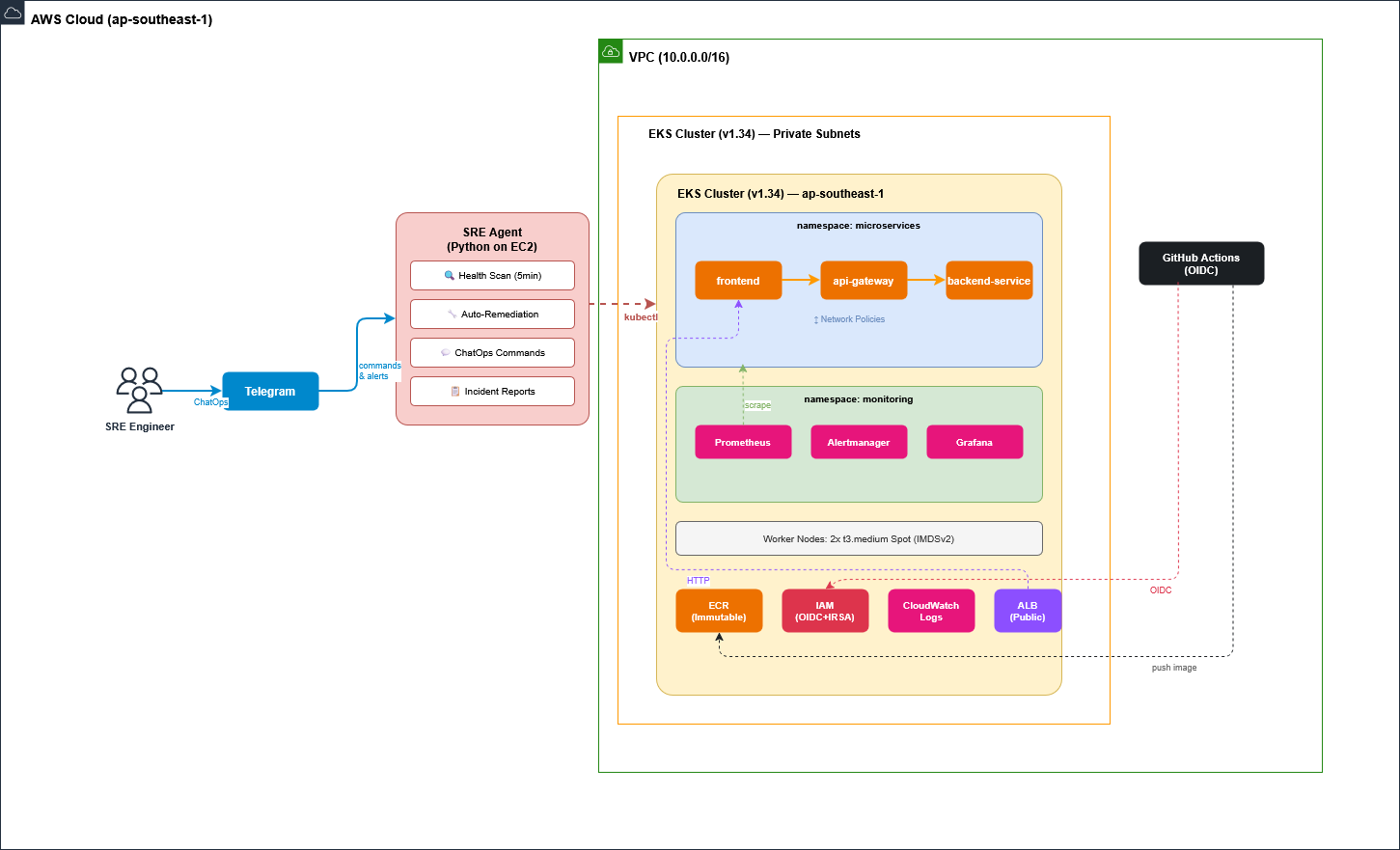
Repo: github.com/ahakimx/eks-microservices-lab
A step-by-step guide to building a Python-based SRE Agent that can scan cluster health, auto-remediate issues, and handle ChatOps commands, running on Amazon EKS.
Prerequisites
- AWS CLI configured + IAM user/role with EKS access
- Terraform >= 1.5
- kubectl
- Docker
- Python 3.11+
- GitHub repo with Actions enabled
Step 1: Provision EKS Cluster with Terraform
1.1 VPC + EKS
1
2
3
4
5
6
7
8
9
10
11
12
13
14
15
16
17
18
19
20
21
22
23
24
25
26
27
28
29
30
31
32
33
34
35
36
37
38
39
40
41
42
43
44
45
46
47
48
49
50
51
52
53
54
# terraform/eks.tf

module "vpc" {
  source  = "terraform-aws-modules/vpc/aws"
  version = "~> 5.5"

  name = "eks-lab-vpc"
  cidr = "10.0.0.0/16"

  azs             = ["ap-southeast-1a", "ap-southeast-1b", "ap-southeast-1c"]
  private_subnets = ["10.0.1.0/24", "10.0.2.0/24", "10.0.3.0/24"]
  public_subnets  = ["10.0.101.0/24", "10.0.102.0/24", "10.0.103.0/24"]

  enable_nat_gateway   = true
  single_nat_gateway   = true
  enable_dns_hostnames = true
}

module "eks" {
  source  = "terraform-aws-modules/eks/aws"
  version = "~> 20.8"

  cluster_name    = "eks-lab"
  cluster_version = "1.34"

  vpc_id     = module.vpc.vpc_id
  subnet_ids = module.vpc.private_subnets

  cluster_endpoint_public_access  = true
  cluster_endpoint_private_access = true

  # Logging for audit trail
  cluster_enabled_log_types = ["api", "audit", "authenticator", "controllerManager", "scheduler"]

  # IRSA enabled
  enable_irsa = true

  eks_managed_node_groups = {
    spot_nodes = {
      instance_types = ["t3.medium"]
      capacity_type  = "SPOT"
      min_size       = 1
      max_size       = 3
      desired_size   = 2

      # IMDSv2 required — prevent SSRF credential theft
      metadata_options = {
        http_endpoint               = "enabled"
        http_tokens                 = "required"
        http_put_response_hop_limit = 1
      }
    }
  }
}
1.2 ECR with Immutable Tags
1
2
3
4
5
6
7
8
9
10
resource "aws_ecr_repository" "services" {
  for_each = toset(["frontend", "api-gateway", "backend-service"])

  name                 = "eks-lab/${each.key}"
  image_tag_mutability = "IMMUTABLE"  # Prevent tag overwrite attacks

  image_scanning_configuration {
    scan_on_push = true  # Auto vulnerability scan
  }
}
1.3 IAM Permission Policy
The IAM user/role running Terraform needs the following policy:
1
2
3
4
5
6
7
8
9
10
11
12
13
14
15
16
17
18
19
20
21
22
23
24
25
26
27
28
29
30
31
32
33
34
35
36
37
38
39
40
41
42
43
44
45
46
47
48
49
50
51
52
53
54
55
56
57
58
59
60
61
62
63
64
65
66
67
68
69
70
71
72
73
74
75
76
77
78
79
80
81
82
83
84
85
86
87
88
89
90
91
92
93
94
95
96
97
98
99
100
101
102
103
104
105
106
107
108
109
110
111
112
113
114
115
116
117
{
  "Version": "2012-10-17",
  "Statement": [
    {
      "Sid": "EKSManagement",
      "Effect": "Allow",
      "Action": [
        "eks:*"
      ],
      "Resource": "*"
    },
    {
      "Sid": "IAMRolesForEKS",
      "Effect": "Allow",
      "Action": [
        "iam:CreateRole",
        "iam:DeleteRole",
        "iam:AttachRolePolicy",
        "iam:DetachRolePolicy",
        "iam:PutRolePolicy",
        "iam:DeleteRolePolicy",
        "iam:GetRole",
        "iam:GetRolePolicy",
        "iam:ListRolePolicies",
        "iam:ListAttachedRolePolicies",
        "iam:TagRole",
        "iam:UntagRole",
        "iam:CreateInstanceProfile",
        "iam:DeleteInstanceProfile",
        "iam:AddRoleToInstanceProfile",
        "iam:RemoveRoleFromInstanceProfile",
        "iam:GetInstanceProfile",
        "iam:ListInstanceProfilesForRole",
        "iam:CreateOpenIDConnectProvider",
        "iam:DeleteOpenIDConnectProvider",
        "iam:GetOpenIDConnectProvider",
        "iam:TagOpenIDConnectProvider",
        "iam:ListOpenIDConnectProviders",
        "iam:CreatePolicy",
        "iam:DeletePolicy",
        "iam:GetPolicy",
        "iam:GetPolicyVersion",
        "iam:ListPolicyVersions",
        "iam:CreatePolicyVersion",
        "iam:DeletePolicyVersion",
        "iam:TagPolicy",
        "iam:UntagPolicy"
      ],
      "Resource": "*"
    },
    {
      "Sid": "PassRoleEKSOnly",
      "Effect": "Allow",
      "Action": "iam:PassRole",
      "Resource": "arn:aws:iam::<account>:role/eks-*",
      "Condition": {
        "StringEquals": {
          "iam:PassedToService": [
            "eks.amazonaws.com",
            "ec2.amazonaws.com"
          ]
        }
      }
    },
    {
      "Sid": "CreateSLREKSOnly",
      "Effect": "Allow",
      "Action": "iam:CreateServiceLinkedRole",
      "Resource": "*",
      "Condition": {
        "StringEquals": {
          "iam:AWSServiceName": "eks.amazonaws.com"
        }
      }
    },
    {
      "Sid": "VPCNetworking",
      "Effect": "Allow",
      "Action": [
        "ec2:*"
      ],
      "Resource": "*"
    },
    {
      "Sid": "ECRManagement",
      "Effect": "Allow",
      "Action": [
        "ecr:*"
      ],
      "Resource": "*"
    },
    {
      "Sid": "CloudWatchLogs",
      "Effect": "Allow",
      "Action": [
        "cloudwatch:*",
        "logs:*"
      ],
      "Resource": "*"
    },
    {
      "Sid": "S3TerraformState",
      "Effect": "Allow",
      "Action": "s3:*",
      "Resource": [
        "arn:aws:s3:::terraform-state-*",
        "arn:aws:s3:::terraform-state-*/*"
      ]
    },
    {
      "Sid": "DynamoDBLock",
      "Effect": "Allow",
      "Action": "dynamodb:*",
      "Resource": "arn:aws:dynamodb:*:*:table/terraform-lock*"
    }
  ]
}
Note: For production, scope down
ec2:*andecr:*to the specific actions needed. The policy above is sufficient for lab/POC purposes.
1.4 GitHub Actions OIDC Role
So that CI/CD doesn’t need to store AWS credentials:
1
2
3
4
5
6
7
8
9
10
11
12
13
14
15
16
17
18
19
20
{
  "Version": "2012-10-17",
  "Statement": [
    {
      "Effect": "Allow",
      "Principal": {
        "Federated": "arn:aws:iam::<account>:oidc-provider/token.actions.githubusercontent.com"
      },
      "Action": "sts:AssumeRoleWithWebIdentity",
      "Condition": {
        "StringEquals": {
          "token.actions.githubusercontent.com:aud": "sts.amazonaws.com"
        },
        "StringLike": {
          "token.actions.githubusercontent.com:sub": "repo:<github-username>/eks-microservices-lab:*"
        }
      }
    }
  ]
}
This role needs the following permissions: ECR push, EKS describe/update-kubeconfig, and kubectl access.
1.5 Deploy
1
2
3
4
5
6
7
cd terraform
terraform init
terraform plan
terraform apply

# Update kubeconfig
aws eks update-kubeconfig --name eks-lab --region ap-southeast-1
Step 2: Deploy Microservices
2.1 Kubernetes Manifests
Key security features in the manifests:
1
2
3
4
5
6
7
8
9
10
11
12
13
14
15
16
17
18
19
20
21
22
23
24
25
26
# k8s/microservices.yaml (excerpt)
spec:
  template:
    spec:
      containers:
        - name: backend-service
          image: <account>.dkr.ecr.ap-southeast-1.amazonaws.com/eks-lab/backend-service:v1.0.0
          resources:
            requests:
              cpu: 100m
              memory: 128Mi
            limits:
              cpu: 250m
              memory: 256Mi
          livenessProbe:
            httpGet:
              path: /health
              port: 3000
          readinessProbe:
            httpGet:
              path: /health
              port: 3000
      # Non-root container
      securityContext:
        runAsNonRoot: true
        runAsUser: 1001
2.2 Network Policies
Traffic flow is restricted: only frontend → api-gateway → backend-service.
1
2
3
4
5
6
7
8
9
10
11
12
13
14
15
16
17
18
apiVersion: networking.k8s.io/v1
kind: NetworkPolicy
metadata:
  name: allow-gateway-to-backend
  namespace: microservices
spec:
  podSelector:
    matchLabels:
      app: backend-service
  policyTypes:
    - Ingress
  ingress:
    - from:
        - podSelector:
            matchLabels:
              app: api-gateway
      ports:
        - port: 3000
2.3 Deploy
1
2
3
4
5
6
7
8
# Build & push (all services)
for svc in frontend api-gateway backend-service; do
  docker build -t <account>.dkr.ecr.ap-southeast-1.amazonaws.com/eks-lab/${svc}:v1.0.0 microservices/${svc}/
  docker push <account>.dkr.ecr.ap-southeast-1.amazonaws.com/eks-lab/${svc}:v1.0.0
done

# Apply manifests
kubectl apply -f k8s/microservices.yaml
Step 3: Setup Monitoring (Prometheus + Grafana)
Deployed via Helm in Terraform:
1
2
3
4
5
6
7
8
9
10
11
12
13
14
15
16
17
18
19
resource "helm_release" "prometheus" {
  name       = "prometheus"
  repository = "https://prometheus-community.github.io/helm-charts"
  chart      = "kube-prometheus-stack"
  namespace  = "monitoring"
  version    = "57.0.1"

  values = [yamlencode({
    grafana = {
      enabled = true
      service = { type = "LoadBalancer" }
    }
    prometheus = {
      prometheusSpec = {
        retention = "7d"
      }
    }
  })]
}
All microservices already have annotations for Prometheus scraping:
1
2
3
4
annotations:
  prometheus.io/scrape: "true"
  prometheus.io/port: "3000"
  prometheus.io/path: "/metrics"
Step 4: CI/CD with GitHub Actions + OIDC
4.1 OIDC Provider (no long-lived credentials)
GitHub Actions authenticates to AWS via OIDC — no need to store AWS keys as secrets.
1
2
3
4
5
6
7
8
9
10
11
12
13
14
15
16
17
18
19
20
21
22
23
24
25
26
27
28
29
30
31
32
33
34
35
36
37
# .github/workflows/deploy.yml
name: Deploy to EKS

on:
  push:
    branches: [main]

permissions:
  id-token: write
  contents: read

jobs:
  deploy:
    runs-on: ubuntu-latest
    steps:
      - uses: actions/checkout@v4

      - name: Configure AWS credentials (OIDC)
        uses: aws-actions/configure-aws-credentials@v4
        with:
          role-to-assume: arn:aws:iam::<account>:role/github-actions-eks-deploy
          aws-region: ap-southeast-1

      - name: Login to ECR
        uses: aws-actions/amazon-ecr-login@v2

      - name: Build & Push
        run: |
          docker build -t $ECR_URL/backend-service:$ .
          docker push $ECR_URL/backend-service:$

      - name: Deploy to EKS
        run: |
          aws eks update-kubeconfig --name eks-lab --region ap-southeast-1
          kubectl set image deployment/backend-service \
            backend-service=$ECR_URL/backend-service:$ \
            -n microservices
Step 5: Build SRE Agent
This is the main part. The SRE Agent is a Python script with two modes:
- Proactive (Scan Mode) — scans cluster health, auto-remediates
- Reactive (ChatOps Mode) — receives commands, executes them, returns results
5.1 Core: Cluster Health Scanner
1
2
3
4
5
6
7
8
9
10
11
12
13
14
15
16
17
18
19
20
21
22
23
24
25
26
27
28
29
30
31
32
33
34
35
36
37
38
39
# agents/sre-agent/sre_agent.py

def scan_cluster_health() -> dict:
    """Full cluster health scan."""
    findings = []

    # 1. Node health — check Ready condition + resource pressure
    rc, out = kubectl("get nodes -o json")
    if rc == 0:
        nodes = json.loads(out)
        for node in nodes.get("items", []):
            name = node["metadata"]["name"]
            conditions = {c["type"]: c["status"] for c in node["status"].get("conditions", [])}
            if conditions.get("Ready") != "True":
                findings.append({
                    "severity": "critical",
                    "type": "node_not_ready",
                    "resource": name,
                    "message": f"Node {name} is NOT Ready",
                    "auto_remediate": False
                })

    # 2. Pod health — CrashLoopBackOff, ImagePullBackOff, Pending
    rc, out = kubectl("get pods -A -o json")
    if rc == 0:
        pods = json.loads(out)
        for pod in pods.get("items", []):
            # ... detect crash loops, image pull errors, stuck pending pods
            pass

    # 3. Deployment health — available vs desired replicas
    # 4. Service endpoints — detect services with no backends

    return {
        "timestamp": datetime.now(timezone.utc).isoformat(),
        "findings": findings,
        "total": len(findings),
        "critical": len([f for f in findings if f["severity"] == "critical"]),
    }
5.2 Auto-Remediation
The agent can auto-fix certain issues (with safety guards):
1
2
3
4
5
6
7
8
9
10
11
12
13
14
15
16
17
18
19
20
def auto_remediate(findings: list) -> list:
    """Auto-remediate findings where possible."""
    actions_taken = []

    for f in findings:
        if not f.get("auto_remediate"):
            continue

        if f["action"] == "restart_pod":
            ns, pod = f["resource"].split("/")
            # Safety: only restart if < 10 restarts (avoid infinite loop)
            if f.get("restart_count", 0) < 10:
                rc, out = kubectl(f"delete pod {pod} -n {ns}")
                actions_taken.append({
                    "finding": f["message"],
                    "action": f"Deleted pod {pod} (will be recreated by deployment)",
                    "success": rc == 0,
                })

    return actions_taken
5.3 ChatOps Commands
The agent can handle interactive commands:
1
2
3
4
5
6
7
8
9
10
11
12
13
14
15
16
17
18
19
20
21
22
23
24
25
26
COMMANDS = {
    "status":   "Show cluster/service status",
    "pods":     "List pods (optional: namespace)",
    "logs":     "Get pod logs (service name, optional: lines)",
    "restart":  "Restart a deployment",
    "scale":    "Scale a deployment",
    "health":   "Full health scan",
    "top":      "Resource usage (nodes/pods)",
    "events":   "Recent cluster events",
    "rollback": "Rollback a deployment",
    "help":     "Show available commands",
}

def handle_command(command: str) -> str:
    """Parse and execute a ChatOps command."""
    parts = command.strip().lower().split()
    cmd = parts[0]
    args = parts[1:]

    if cmd == "status":
        return cmd_status(args)
    elif cmd == "restart":
        return cmd_restart(args)
    elif cmd == "scale":
        return cmd_scale(args)
    # ... etc
5.4 Usage
1
2
3
4
5
6
7
8
9
10
# Proactive scan mode (e.g., via cron/scheduled job)
python sre_agent.py

# ChatOps mode (handle specific command)
python sre_agent.py status
python sre_agent.py pods microservices
python sre_agent.py restart backend-service
python sre_agent.py scale frontend 3
python sre_agent.py health
python sre_agent.py rollback api-gateway
Step 6: IRSA for SRE Agent (Least Privilege)
If the agent needs AWS API access (e.g., describe instances, read CloudWatch), use IRSA:
1
2
3
4
5
6
7
8
9
10
11
12
13
14
15
16
17
# IAM role for SRE Agent pod
module "sre_agent_irsa" {
  source  = "terraform-aws-modules/iam/aws//modules/iam-role-for-service-accounts-eks"

  role_name = "sre-agent-role"

  oidc_providers = {
    main = {
      provider_arn               = module.eks.oidc_provider_arn
      namespace_service_accounts = ["microservices:sre-agent"]
    }
  }

  role_policy_arns = {
    readonly = "arn:aws:iam::aws:policy/ReadOnlyAccess"
  }
}
1
2
3
4
5
6
7
8
# K8s ServiceAccount
apiVersion: v1
kind: ServiceAccount
metadata:
  name: sre-agent
  namespace: microservices
  annotations:
    eks.amazonaws.com/role-arn: arn:aws:iam::<account>:role/sre-agent-role
Step 7: Run the Agent as a CronJob
1
2
3
4
5
6
7
8
9
10
11
12
13
14
15
16
17
apiVersion: batch/v1
kind: CronJob
metadata:
  name: sre-agent-scan
  namespace: microservices
spec:
  schedule: "*/5 * * * *"  # Every 5 minutes
  jobTemplate:
    spec:
      template:
        spec:
          serviceAccountName: sre-agent
          containers:
            - name: sre-agent
              image: <account>.dkr.ecr.ap-southeast-1.amazonaws.com/eks-lab/sre-agent:v1.0.0
              command: ["python", "sre_agent.py"]
          restartPolicy: OnFailure
Security Highlights
| Layer | Implementation |
|---|---|
| OIDC | GitHub Actions → AWS without long-lived credentials |
| IRSA | Pod-level IAM, not shared node credentials |
| IMDSv2 | Prevents SSRF credential theft on worker nodes |
| Immutable Tags | ECR image tags cannot be overwritten |
| Network Policies | Pod-to-pod traffic restricted (frontend→gateway→backend) |
| Non-root | All containers run as UID 1001 |
| ECR Scan | Auto vulnerability scan on push |
| Encryption | EBS encrypted, EKS secrets encrypted at rest |
| Auto-remediation guard | Max restart count check, prevents infinite loops |
Sample Output
Scan Mode (All Clear)
✅ SRE Agent Scan — All Clear

Cluster healthy. No issues detected.
Scan Mode (Issues Found)
🚨 SRE Agent Scan — 2 issue(s)
⏰ 2026-05-25T09:30:00+00:00

🔴 Critical: 1 | 🟠 High: 1 | 🟡 Warning: 0

🔴 [crash_loop] Pod backend-service-abc123 in microservices is CrashLoopBackOff (restarts: 4)
🟠 [deployment_degraded] Deployment backend-service in microservices: 1/2 replicas available

Auto-remediation actions:
✅ Deleted pod backend-service-abc123 (will be recreated by deployment)
ChatOps: status
📊 Cluster Status

🖥 Nodes: 2/2 ✅
📦 Pods: 12/12 ✅

⚙️ Services:
  🟢 frontend           2/2
  🟢 api-gateway        2/2
  🟢 backend-service    2/2
Next Steps
- Slack/Discord integration — send alerts and receive commands via webhook
- PagerDuty integration — escalate critical findings
- Runbook automation — expand auto-remediation rules
- ML-based anomaly detection — predict issues before they happen
- Multi-cluster support — scan multiple EKS clusters
Conclusion
With this setup, you have:
- EKS cluster that is production-grade (Spot nodes, private subnets, encrypted)
- Microservices with proper health checks, resource limits, and network isolation
- Monitoring via Prometheus + Grafana
- CI/CD that is secure (OIDC, no stored credentials)
- SRE Agent that can proactively detect issues, safely auto-fix them, and respond to ChatOps commands
Total cost for this lab: ~$3-5/day (Spot instances + NAT Gateway). Suitable for learning and POC before scaling to production.
Built with ☕ by Abdul Hakim